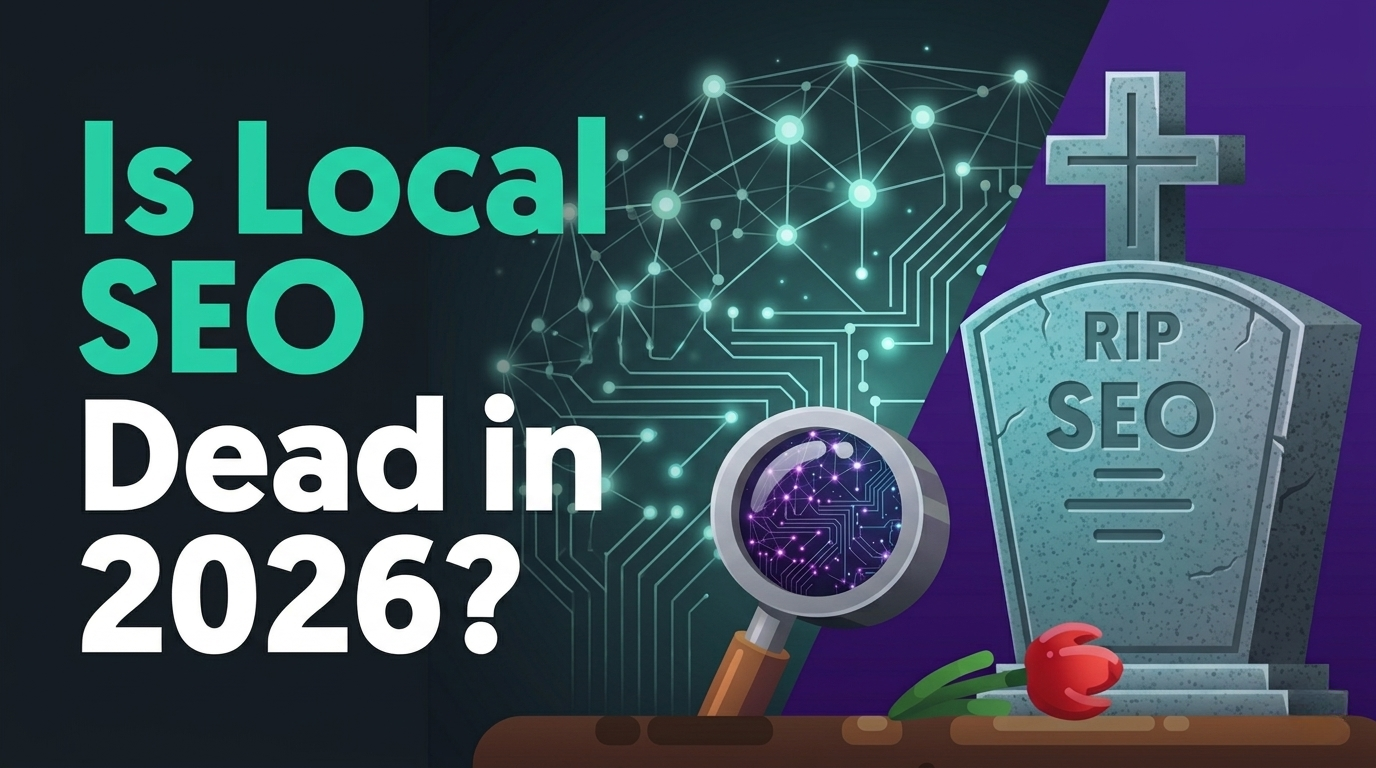
No, Local SEO is not dead in 2026. What has actually died is the old version of Local SEO that depended only on keywords, backlinks, and basic Google Maps optimisation. Today, search is powered by AI systems like Google’s AI Overviews, ChatGPT, and Perplexity, which no longer “rank websites” in the traditional sense. Instead, they recommend businesses as answers. This shift is what experts now call GEO (Generative Engine Optimisation).
Local SEO still exists and continues to drive leads, especially for service-based businesses, but it now works alongside AI systems that evaluate trust, reputation, sentiment, and structured data. So instead of optimising only for Google search results, businesses must now optimise for “answer engines” that decide who gets recommended. If your business is not structured properly for AI understanding, you will lose visibility even if you previously ranked on page one.
What Has Changed in Local Search Behaviour?
Search behaviour has completely shifted from typing keywords to asking full natural-language questions. Users are no longer searching “dentist Austin” or “HVAC repair near me” in a basic way. Instead, they are asking complex intent-based queries like: “Find me a dentist in Austin who accepts insurance and has availability tomorrow morning.” This means Google is no longer just matching words; it is interpreting intent, urgency, and trust.
AI systems now act like decision-makers rather than directors. They analyse reviews, business reputation, content consistency, and even social proof before recommending a service. This is why businesses that still rely only on old Local SEO tactics are seeing fluctuating visibility.
The biggest change is the local seo: users don’t browse results anymore as they receive answers. That means your business must be structured as the best possible answer across the internet, not just a listing on Google Maps.
Why is Traditional Local Seo Is Becoming Weaker?
Traditional Local SEO is becoming less powerful because Google itself has changed into an “answer engine.” The old model relied heavily on:
- Exact keyword matching
- Backlinks and citations
- Google Business Profile optimization
- Location-based ranking signals
While these still matter, they are no longer enough on their own. AI now filters results before users even click. In many cases, users never reach websites because Google or AI systems directly provide summaries.
Another major issue is zero-click search, where users get answers directly on the results page. This reduces traffic even for top-ranking businesses. At the same time, AI Overviews push organic listings further down, reducing visibility.
However, this does not mean SEO is useless. It may leave people wondering what is local SEO, but it means SEO is no longer just about ranking; it is about being selected as a trusted entity.
What Replaced Local Seo with Geo (Generative Engine Optimisation)?
GEO is the next stage of SEO evolution. Instead of optimising for search engines that list websites, GEO focuses on optimising for AI systems that generate answers. These systems decide which business to recommend based on trust, relevance, and context rather than just keywords.
In GEO, your business is evaluated like a “knowledge entity.” That means AI looks at everything available about your brand across the internet. It checks consistency, authority, sentiment, and real-world engagement.
The goal is no longer to rank #1 on Google but rather to become the most likely recommendation across AI engines. This shift changes everything about how local businesses must approach digital marketing.
The 3 Pillars of Modern Geo for Local Businesses
The 3 pillars of modern GEO for local businesses, which were previously called “local SEO,” are the following:
1. Sentiment-Driven Reputation Signals
AI systems now analyse reviews deeply instead of just counting ratings. They look at emotional tone, service details, and consistency of experience. A business with fewer but highly detailed positive reviews often outranks a business with hundreds of generic reviews.
Descriptive reviews help AI understand your strengths. For example, reviews that mention speed, professionalism, pricing transparency, or problem-solving carry more weight than simple “good service” comments. This makes reputation management more important than ever.
- Focus on detailed customer feedback.
- Encourage story-based reviews
- Respond to reviews in a meaningful way
2. Structured Data and Entity Clarity
Structured data is now a critical ranking factor in AI search. Your business must be clearly defined across all platforms so AI systems can confidently identify who you are, what you do, and where you operate.
Consistency is key here. If your business information varies across directories, AI may reduce trust in your entity. Schema markup, Google Business Profile optimisation, and cross-platform consistency all help build a strong digital identity.
Businesses that invest in SEO services focused on structured data often gain a strong advantage in AI visibility because their information becomes easier for machines to interpret.
- Keep NAP consistent everywhere.
- Use schema markup on your website
- Link social profiles and listings
- Maintain accurate service categories
3. Real-Time Activity and Local Relevance
AI systems prioritise active businesses over static ones. If your business looks updated and engaged, it is more likely to be recommended. Activity signals include posts, updates, seasonal offers, and engagement with local trends.
For example, a business that posts about weather-based service demand or local events appears more relevant than a business that rarely updates its profile. This signals that the business is operational and responsive.
- Post regularly on Google Business Profile.
- Add updated photos frequently
- Mention local events or conditions
- Respond quickly to customer queries
How AI Decides Which Local Business to Recommend?
AI does not rely on a single ranking factor. Instead, it builds a confidence score using multiple signals. These include reputation across the web, brand mentions, structured data consistency, and sentiment analysis.
If your business is frequently mentioned on platforms like Reddit, blogs, and local directories, AI sees it as more trustworthy. If your competitors have stronger online discussions and reviews, they may outrank you, even if your website is better optimised.
This is why brand presence matters more than ever. SEO is no longer isolated to your website; it is distributed across the entire internet.
The Role of Local Seo in the AI Era
Local SEO is still extremely important because it remains the foundation of visibility on Google Maps and local searches. However, it now feeds directly into GEO systems.
Local SEO still includes:
- Google Business Profile optimization
- Local citations and directories
- Location-based keywords
- Customer reviews and ratings
- Local backlinks
But the difference is that these signals are no longer just for Google, as they are also used by AI systems to build trust. So instead of replacing Local SEO, GEO is built on top of it. Both must work together for full visibility.
Why Seo Is Expanding into “Search Everywhere Optimisation.”?
Search is no longer limited to Google. People now discover businesses through multiple platforms, including TikTok, YouTube, Reddit, Amazon, and AI tools. This means your optimisation strategy must extend beyond traditional search engines.
Modern visibility depends on where your audience spends time and how they discover information. For example, a restaurant might gain more customers from TikTok videos than from Google search. Similarly, Reddit discussions often influence AI recommendations.
This shift means businesses must think beyond rankings and focus on presence everywhere their audience exists.
Key Differences Between Old SEO and New GEO-driven SEO
- Old SEO focused on keywords; GEO focuses on intent
- Old SEO focused on backlinks; GEO focuses on trust signals
- Old SEO focused on rankings; GEO focuses on recommendations
- Old SEO focused on websites; GEO focuses on the entire online presence
This is why many traditional SEO strategies are becoming outdated.
What Businesses Should Do Now?
To stay competitive in 2026, businesses must adapt their strategy to both Local SEO and GEO. The goal is no longer just traffic, as it is authority and recommendation power.
Focus on:
- Building strong review ecosystems
- Creating structured and consistent business data
- Increasing brand mentions across platforms
- Publishing high-quality, helpful content
- Staying active on Google Business Profile
Businesses that adapt early will dominate both Google and AI-driven search systems.
Conclusion
Local SEO is not dead in 2026. It has simply evolved into a more advanced system powered by AI and generative engines. The future of search is not about ranking pages; it is about becoming the most trusted answer.
Businesses that still rely only on traditional SEO will see reduced visibility over time. But those that combine Local SEO fundamentals with GEO strategies will gain a strong competitive advantage. The future belongs to businesses that are not just searchable but also recommendable.
FAQS
1. Is Local SEO still worth it in 2026?
Yes, Local SEO is still highly valuable because customers still use Google Maps and “near me” searches for buying decisions. However, it now works together with AI systems like ChatGPT and Google AI Overviews, so businesses must also focus on trust signals, reviews, and structured data.
2. What is the difference between Local SEO and GEO?
Local SEO focuses on ranking in Google Maps and local search results, while GEO (Generative Engine Optimisation) focuses on getting your business recommended by AI tools. GEO looks at sentiment, authority, and consistency across the internet instead of just keywords and backlinks.
3. How can I improve my local rankings in 2026?
To improve rankings, you need a mix of traditional and AI-ready optimisation. This includes optimising your Google Business Profile, collecting detailed customer reviews, maintaining NAP consistency, using schema markup, and staying active with regular updates and local content.
4. Why is my business not showing in Google Maps anymore?
This usually happens due to weak trust signals, inconsistent business information, poor review quality, or low engagement. In 2026, Google and AI systems prioritise active, trusted, and well-documented businesses, not just keyword-optimised listings.