


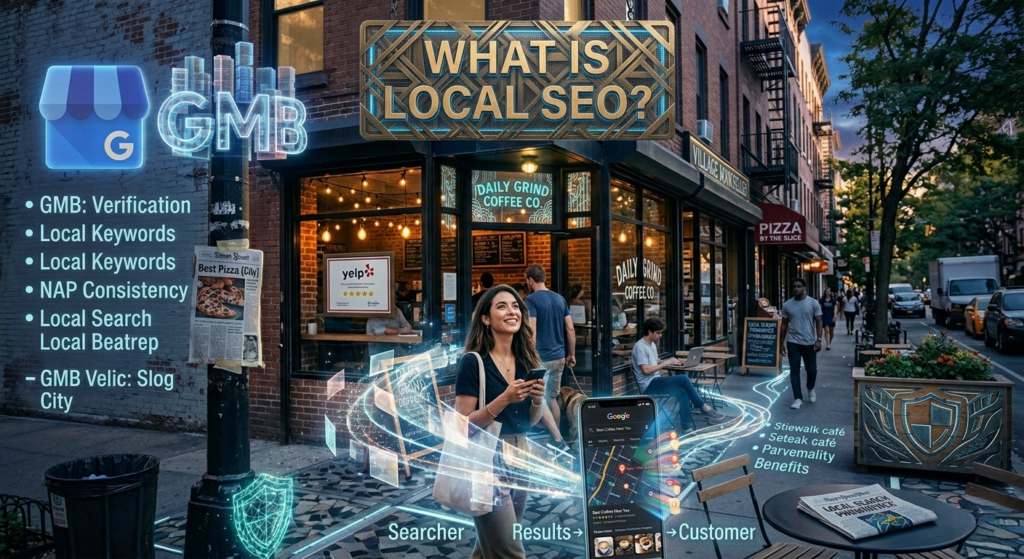
Local SEO (Local Search Engine Optimisation) is the process of improving a business’s online presence to appear in location-based searches such as “near me” queries, Google Maps, and local search results. It helps businesses attract nearby customers by optimising Google Business Profiles, local keywords, citations, reviews, and website content. Local SEO is important for UK businesses because it increases visibility, drives local traffic, generates enquiries, and helps small businesses compete with larger brands. Unlike traditional SEO, Local SEO focuses on geographic targeting, Google Maps visibility, and local customer intent.
What Is Local SEO?
Local SEO (Local Search Engine Optimisation) is the process of optimising a business’s online presence so it appears in relevant, location-based searches on Google and other search engines.
It focuses specifically on helping companies show up when users search for:
- Services near me, for example, “best coffee shop near me”
- Businesses in a city or postcode, such as “car mechanic in Birmingham”
- Map results and local business listings
Local SEO prioritises geographic relevance so users in your city, town, or region can discover your business easily.
What is Local SEO in Digital Marketing?
Local SEO in digital marketing means shaping your online content, profiles, and local signals so search engines understand:
- Your service or product
- Where are you located
- Which searches are you relevant for
- That you deserve to be shown in the local pack, Google Maps, and local search results
This makes Local SEO one of the most powerful tools for growing foot traffic, enquiries, and sales from nearby customers.
What Does Google’s Local Algorithm Look At?
Google’s local algorithm looks at local search results. On the other hand, Google’s local algorithm considers multiple factors to determine which businesses appear in the Map Pack and local search results.
Key ranking signals include the following:
- Proximity: How close your business is to the searcher’s location.
- Relevance: How well your business matches the search query (e.g., “emergency plumber Birmingham”).
- Prominence: How well-known and trusted your business is online, including reviews, backlinks, and citations.
- Google Business Profile Optimisation: Complete and accurate GBP with categories, descriptions, photos, and services.
- NAP Consistency: Name, Address, and Phone number consistently listed across directories.
- Reviews and Ratings: Quantity and quality of customer reviews influence trust and visibility.
- Behaviour Signals: Click-through rates, website engagement, and direction requests.
Understanding these factors helps UK businesses focus on the elements that truly impact local search visibility.
Why Local SEO Matters for UK Businesses?
Local SEO matters because modern search behaviour is highly local.
46% of all searches on Google are local
Almost half of all Google searches include local intent, whether it is an explicit place name or a “near me” search. Users are actively seeking local information such as opening hours, contact details, and directions.
High-intent searchers
Local searchers are often ready to act, meaning they want to call, visit, or buy now.
For example:
- Someone searching “plumber in London” probably needs immediate services
- Someone searching “best fish and chips in Bristol” is likely planning a visit soon
This makes Local SEO much more valuable than general SEO for businesses with real-world locations.
Competes with bigger brands
With good Local SEO services, small UK businesses can outrank national chains for local searches, giving them a competitive edge.
Cost-effective marketing
Compared with paid ads, Local SEO has long-term return on investment, with traffic and leads continuing to flow without ongoing advertising costs.
Essential for physical locations
Shops, restaurants, salons, tradespeople, and health professionals benefit the most, as Local SEO connects them directly with customers in their area.
What are the Key Components of Local SEO?
The key components of local SEO include GBP, local keywords, citations, reviews, on-page SEO, backlinks and local links.
1. Google Business Profile (GBP)
Your Google Business Profile (formerly Google My Business) is the most important Local SEO ranking factor. This profile appears in search results on Google and Google Maps when someone searches for local businesses.
Key elements of GBP include:
- Business name
- Star rating
- Opening hours
- Directions
- Reviews
- Photos
- Website link
Optimising your Google Business Profile allows your business to appear in the “local pack,” the top three local results that often show above organic listings.
2. Local Keywords
Local keywords include:
- Location names (e.g., “plumber in London”)
- “Near me” phrases (e.g., “dentist near me”)
- Postcodes or regions (e.g., “hairdresser SW1”)
Use them naturally in your website’s:
- Homepage content
- Meta titles and descriptions
- Headings (H1, H2)
- URLs and image alt text
This helps search engines understand which searches your business should appear for.
3. Local Citations
Citations are mentions of your business name, address, and phone number (NAP) across trusted websites such as:
- Yelp
- Yell
- Thomson Local
- Local business directories
- Industry-specific websites
Consistent NAP information across multiple sites helps search engines trust your business location.
4. Reviews and Trust Signals
Online reviews, particularly on Google, influence both rankings and consumer trust. Positive reviews:
- Boost credibility
- Improve local rankings
- Increase click-through rates
- Generate more customer enquiries
Actively managing and collecting reviews is crucial for Local SEO.
5. On-Page Local SEO
Optimising your website for local search involves:
- Creating location pages
- Using local keywords in content
- Embedding maps and contact details
- Publishing localised blog content
These actions reinforce your relevance for location-based searches.
6. Backlinks and Local Links
Links from authoritative, local, or industry-related sites improve your business’s trustworthiness and Local SEO power.
How Does Local SEO Work?
Local SEO works by optimizing your business profile, using local keywords, maintaining citations, collecting reviews, and then monitoring performance.
Here is a simple process for understanding how Local SEO functions:
Step 1 – Optimise Google Business Profile
Claim your profile, verify it, and complete all fields accurately, including:
- Business category
- Description of services
- Photos
- Opening hours
- Phone number
- Website URL
A fully optimised GBP ensures Google has accurate data about your business.
Step 2 – Use Local Keywords
Research relevant local keywords using tools like Google Keyword Planner, Ahrefs, or Ubersuggest. Include these keywords in:
- Website pages
- Service descriptions
- Meta tags and headings
Step 3 – Build and Maintain Consistent Citations
Ensure your NAP details are consistent across:
- Local directories
- Social media platforms
- Industry-specific websites
Consistency is vital for ranking accuracy.
Step 4 – Collect and Manage Reviews
Encourage customers to leave reviews and respond professionally to all feedback. Reviews improve credibility and visibility.
Step 5 – Monitor Performance
Use analytics tools to track:
- Views
- Clicks
- Direction requests
- Website visits
- Calls
Refine your strategy based on measurable results.
Local SEO Strategy Examples
Local SEO strategies can vary depending on the type of business. Here are some real-world examples to show how different UK businesses apply Local SEO to improve visibility and attract local customers.
Example 1 – Small Businesses
For small businesses like cafés or boutique shops, the focus is on local search visibility and customer footfall.
A café in Edinburgh targets keywords like:
- “Cafe near Edinburgh Waverley”
- “Best breakfast cafe in Edinburgh”
They optimise their Google Business Profile, create a local landing page, gather reviews, and produce local blog content highlighting Edinburgh attractions.
Example 2 – Local Services
Service providers like plumbers or electricians use Local SEO to attract clients searching for immediate, nearby services.
A plumber in Birmingham targets keywords like:
- “Emergency plumber Birmingham”
- “24 hour plumber B15 postcode”
They optimise service pages, add FAQs, and embed Google Maps on their site to improve visibility and trust.
Example 3 – Retail Businesses
Retail shops focus on driving in-store visits and local awareness.
A boutique in Brighton targets:
- “Boutique clothing shop Brighton”
- “Women’s fashion near me”
Their strategy includes local backlinks, influencer partnerships, and content around local events to engage nearby customers.
How Do AI and GEO Improve Local SEO?
AI and GEO improve local SEO as:
- AI in Local SEO: AI helps analyse search patterns, predict user intent, generate localised content, and optimise Google Business Profiles automatically.
- Geolocation (GEO) targeting: Enables your website to adapt content based on the user’s real-time location, showing relevant products or services.
- Combined effect: Businesses can serve more personalised results, improve visibility for “near me” searches, and attract high-intent local customers.
AI and GEO technologies help UK businesses optimise Local SEO dynamically and with better targeting than manual methods.
What are the Key Differences Between Local SEO and Traditional SEO?
The key difference between local SEO and traditional SEO includes location focus, ranking priorities, keyword use, and citation. The table below highlights the main differences between these two approaches, so you can see why local optimisation requires specific strategies and focus.
| Local SEO | Traditional SEO |
| Focuses on a specific location | Focuses on national/global audience |
| Prioritises Map Pack and Google Business | Prioritises general organic ranking |
| Uses local keywords (e.g., “plumber in Leeds”) | Uses broader keywords (e.g., “how to fix a boiler”) |
| Relies on citations and Google Business Profile | Relies on backlinks and content authority |
| Targets proximity, reviews, and trust | Targets authority, relevance, and content quality |
The above table shows that the Local SEO focuses on proximity, user location, and local ranking factors, while traditional SEO services focus on broader visibility across the web.
How Does Google Rank Search Results?
Google ranks search results by considering three major signals:
- Relevance: Does your business match the search query?
- Distance: How close is your business to the user’s location or specified area?
- Prominence: How well-known your business is based on reviews, links, and citations.
For example, two restaurants in Manchester might both serve Italian cuisine, but the one closer to the searcher with better reviews and optimised GBP will appear first. Understanding these ranking factors allows UK businesses to focus on elements that improve their local search performance efficiently.
What are the Common Tools for Local SEO?
Some Common and popular tools for local SEO include the following:
- Google Business Profile (GBP): Monitor and optimise your listing, post updates, and reply to reviews.
- Google Maps and Google Search Console: Track how customers find your business and spot local search trends.
- BrightLocal: Audit local citations, track rankings, and monitor reviews.
- Moz Local: Maintain NAP consistency and manage directory listings.
- SEMrush and Ahrefs: Keyword research, local competitor analysis, and backlink tracking.
- Yext: Manage business information across multiple directories.
Using these tools, UK businesses can ensure their online presence is consistent, relevant, and optimised for local searches.
Why Local SEO for Small Businesses in the UK is Essential?
Local SEO is essential for UK businesses because:
- Most customers search online before visiting
- Competition in major cities is high
- Mobile searches are increasingly location-based
- People trust local listings over general ads
Examples of local UK searches include:
- “Best pizza in Manchester”
- “Car repairs near me Leeds”
- “Dentist open now Birmingham”
- “Garden services London SE1”
Is Local SEO Worth It?
Yes. Local SEO connects businesses with customers ready to act. It helps small businesses outrank competitors, increases visibility without constant ad spend, and builds long-term credibility.
Local SEO is especially valuable for:
- Physical stores
- Local service providers
- Businesses seeking cost-effective marketing strategies
What are Common Local SEO Mistakes?
The common Local SEO mistakes include inconsistent NAP (Name, Address, Phone Number), ignoring reviews, not optimizing the GBP (Google Business Profile), missing local keywords, and not monitoring performance regularly. Avoid these errors to ensure better results.
- Inconsistent NAP across directories
- Ignoring reviews
- Not claiming or optimising GBP
- Not using local keywords
- Failing to monitor performance
Correcting these mistakes can significantly improve rankings.
Final Thoughts
For any business that relies on local customers, Local SEO should be a top priority. It is a practical, measurable strategy that helps UK businesses be found on Google, attract nearby customers, and grow traffic, leads, and revenue.
FAQS
What is the difference between Local SEO and regular SEO?
Local SEO focuses on location-based ranking and visibility, whereas regular SEO targets broader national or global audiences.
What is an example of Local SEO?
Optimising a Google Business Profile for a hair salon in London to appear in searches like “hairdresser near me London.”
What is Local SEO in business?
It is a strategy used to help local customers find your products or services online.
What is Local SEO and how does it work?
It works by optimising your online presence, citations, maps listings, reviews, and website content to match local search intent.
Why is Local SEO important?
It connects businesses with high-intent local customers ready to call, visit, or buy.