


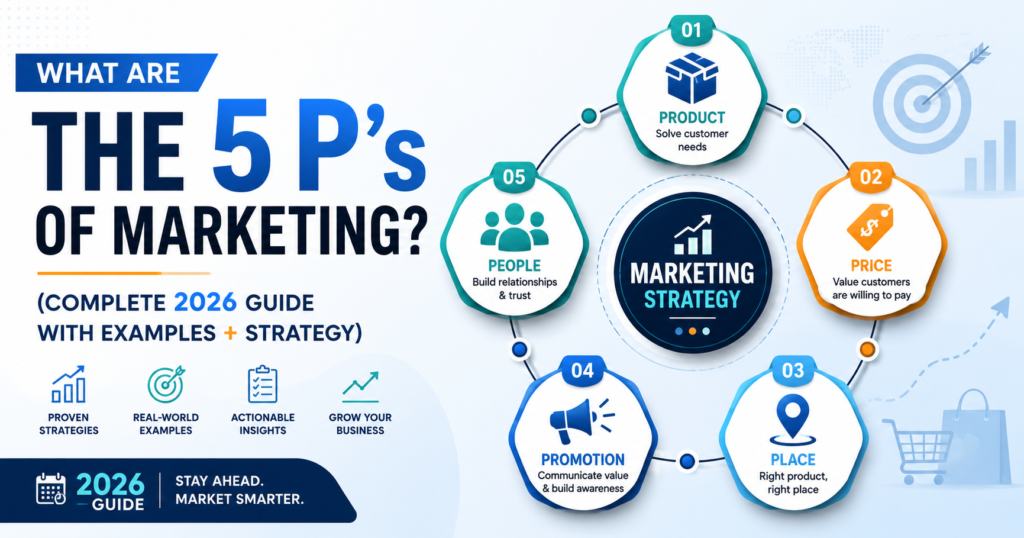
The 5 P’s of marketing are Product, Price, Place, Promotion, and People, which together form a strategic framework used to attract customers, build brand value, and increase sales. The framework helps businesses align product development, pricing, distribution, advertising, and customer experience to create a complete and effective marketing strategy.
The 5 P’s of marketing strategy focus on delivering the right product at the right price, through the right channels, with the right promotion, and supported by the right people. Product covers quality, features, branding, and customer experience; Price determines market positioning and profitability; Place focuses on physical and digital distribution channels; Promotion includes advertising, SEO, content marketing, and social media campaigns; while People refers to employees, customer service, and audience interaction that shape brand trust and loyalty.
The framework is also widely applied in content marketing, where businesses use valuable content, strategic distribution, audience targeting, and promotional methods to increase engagement and conversions. In modern digital marketing, the 5 P’s remain important because they combine traditional business strategy with SEO, AI-driven discovery, branding, and customer experience to build scalable and long-term business growth.
What are the 5 P’s of Marketing?
The 5 P’s of marketing are a core strategic framework used by businesses to plan, position, and promote their products effectively in the market. It helps companies understand how to deliver value to customers and build long-term brand success.
The 5 P’s of marketing include:
- Product
- Price
- Place
- Promotion
- People
Together, these elements form a complete system that shapes how a business attracts customers, competes in the market, and generates sales.
Unlike random marketing tactics, the 5 P’s marketing strategy ensures every decision is structured around customer needs and business goals. This framework is widely used in both traditional businesses and modern digital marketing, including e-commerce and content marketing strategies.
What are the 5 P’s of Marketing Strategy?
A 5 Ps marketing strategy is a structured approach where businesses align all five elements to create a consistent and profitable marketing system.
Instead of focusing only on advertising, this strategy ensures that:
- The product matches customer demand
- Pricing reflects value and competition
- Distribution channels are optimized
- Promotion reaches the right audience
- People deliver strong customer experiences
When all five elements work together, businesses create a strong brand ecosystem that increases trust, conversions, and long-term growth.
In modern digital marketing, this strategy is also used in SEO, content marketing, and branding campaigns to ensure consistency across all channels.
Product in the 5 P’s of Marketing
The product is the core of your entire marketing strategy. It represents what you are offering to solve a customer problem or fulfill a need.
It includes:
- Product design and features
- Quality and performance
- Branding and packaging
- Variations and product range
- Customer experience with the product
A strong product must solve a real problem. Without a good product, even the best marketing cannot succeed.
5 Ps of marketing examples (Product)
- Apple iPhone focuses on premium design and ecosystem integration
- Nike shoes focus on performance, comfort, and athletic branding
- Amazon products focus on convenience and fast delivery experience
In all these cases, the product is designed not just to sell, but to create a complete customer experience.
Price in the 5 P’s of Marketing
Price refers to how much customers pay for your product or service. It directly impacts demand, perception, and profitability.
Pricing includes:
- Base price of the product
- Discounts and offers
- Payment plans or subscriptions
- Psychological pricing strategies
- Competitive pricing in the market
Price is not just about being cheap or expensive—it is about positioning. A high price can signal premium quality, while a low price can attract mass-market customers.
5 Ps of marketing examples (Price)
- Luxury brands like Rolex use high pricing to signal exclusivity
- Walmart uses low pricing to attract budget-conscious customers
- Netflix uses subscription pricing for recurring revenue
Pricing must always align with brand positioning and customer expectations.
Place in the 5 P’s of Marketing
Place refers to distribution channels, where and how customers can access your product.
It includes:
- Physical stores
- E-commerce websites
- Marketplaces like Amazon or Daraz
- Mobile apps
- Social commerce platforms
In digital marketing, “place” is no longer just physical location—it includes online visibility and accessibility.
5 Ps of marketing examples (Place)
- Nike sells through retail stores, websites, and apps
- Amazon operates as a global online marketplace
- Local restaurants use delivery apps like Foodpanda or Uber Eats
If customers cannot easily find your product, even strong marketing will fail.
Promotion in the 5 P’s of Marketing
Promotion refers to all activities used to create awareness and drive sales. It is how you communicate your value to potential customers.
It includes:
- Advertising (Google Ads, social media ads)
- SEO and content marketing
- Influencer marketing
- Email marketing
- Public relations
- Social media campaigns
Promotion is what connects your product to your audience.
5 Ps of marketing examples (Promotion)
- Coca-Cola uses global advertising campaigns
- Brands use Instagram influencers for product launches
- Google SEO helps businesses get organic traffic
Promotion ensures your product is visible in a competitive market.
People in the 5 P’s of Marketing
People refer to everyone involved in the customer experience:
- Employees
- Customer support teams
- Sales staff
- Target audience
In modern marketing, “People” is one of the most important elements because customers value experience as much as product quality.
Strong customer interaction builds trust and loyalty, which directly impacts brand success.
5 Ps of marketing examples (People)
- Amazon is known for strong customer service support
- Apple focuses on in-store customer experience
- Zappos built its brand through customer-first service culture
A business with great people can outperform competitors even with similar products.
What are the 5 P’s of Content Marketing?
The 5 P’s of content marketing are an adaptation of the traditional model applied to digital content strategy. They help businesses create content that attracts, engages, and converts audiences.
In content marketing, the 5 P’s include:
- Product: the topic or content offering
- Price: the value or cost (free vs gated content)
- Place: platforms where content is published
- Promotion: how content is distributed
- People: audience and content creators
For example:
- A blog post (product)
- Free SEO guide (price = free value)
- Published on website (place)
- Promoted via social media (promotion)
- Targeted at business owners (people)
This framework ensures content is not random but strategic and conversion-focused.
How to Use the 5 Ps Effectively in Marketing?
To successfully use the 5 Ps marketing strategy, businesses must align all five elements instead of treating them separately.
Here is how to use them effectively:
- Start by designing a strong product that solves real problems
- Set a price that reflects value and market positioning
- Choose the right place where your customers are active
- Build a strong promotion strategy using SEO, ads, and content
- Focus on people by improving customer experience and trust
When all five elements are aligned, marketing becomes more consistent and scalable.
Unique insight: The 6th P in Marketing (most people don’t talk about this)
Most marketers stop at the 5 P’s, but modern marketing requires one more hidden factor: Perception. Perception is how customers feel and interpret your brand before and after interacting with it.
It is shaped by:
- Online reviews
- Social media presence
- Brand storytelling
- User-generated content
- AI-generated recommendations
Even if your product, price, place, promotion, and people are perfect, poor perception can still reduce conversions.
For example:
- A brand with strong reviews but average pricing can outperform a cheaper competitor
- A brand mentioned positively on social media can gain trust faster than ads alone
In 2026, perception is heavily influenced by AI systems like Google AI Overviews and ChatGPT, which summarize public sentiment before recommending businesses. This makes perception a powerful “hidden P” in modern marketing.
Why Do the 5 Ps Still Matter in 2026?
The 5 P’s of marketing remain one of the most powerful frameworks in business strategy because they connect all key elements of success such as product, pricing, distribution, promotion, and people.
Even in the digital era of AI, SEO, and automation, this model still works because it focuses on fundamentals that never change: customer value and experience.
When combined with modern strategies like SEO, content marketing, and AI-driven discovery, the 5 P’s become even more powerful. Businesses that master this framework don’t just sell products; they build strong, scalable, and trusted brands.
FAQS
1. What are the 5 P’s of marketing?
The 5 P’s of marketing are Product, Price, Place, Promotion, and People. Together, they form a framework used to plan and execute a complete marketing strategy that focuses on customer needs and business growth.
2. What is the importance of the 5 P’s marketing strategy?
The 5 P’s marketing strategy is important because it helps businesses balance all key areas of marketing. It ensures the product is right, the price is competitive, the place is accessible, promotion is effective, and people deliver a strong customer experience.
3. What are the 5 P’s of content marketing?
The 5 P’s of content marketing include using Product (content topic), Price (value or free/gated content), Place (platforms like blogs or social media), Promotion (distribution strategies), and People (target audience and creators) to build effective content strategies.
4. Can you give simple 5 P’s of marketing examples?
Yes. For example, Apple focuses on premium Product, high Price, global online and retail Place, strong Promotion through ads, and excellent customer-focused People experience. Each element works together to strengthen the brand.