


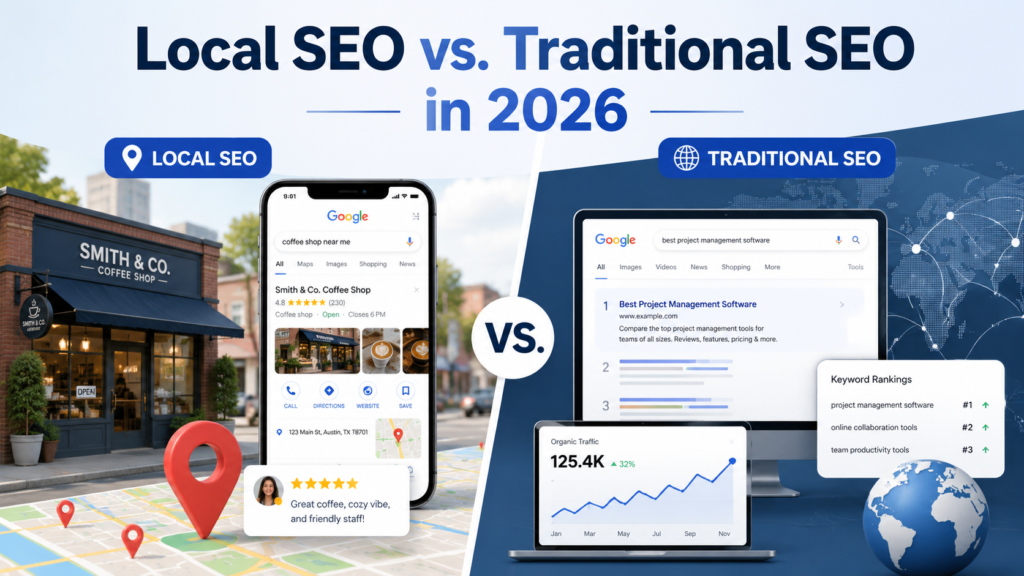
Local SEO and Traditional SEO are two core digital marketing strategies that help businesses improve online visibility, attract customers, and increase search engine rankings, but they differ in search intent, ranking factors, platforms, and conversion goals. Local SEO focuses on location-based searches, Google Maps visibility, and nearby customer acquisition through factors such as Google Business Profile optimisation, reviews, citations, and proximity signals. Traditional SEO focuses on improving website authority and organic rankings through content creation, keyword optimisation, backlinks, technical SEO, and informational search visibility.
The differences between Local SEO and Traditional SEO include search intent focus, ranking platforms, ranking factors, competition scope, conversion speed, and AI-driven search impact. In 2026, both strategies are also influenced by AI systems and Generative Engine Optimisation (GEO), making hybrid optimisation essential for businesses that want both local visibility and long-term organic authority.
Search has changed more in the last few years than in the previous decade combined. Businesses are no longer competing only for rankings on Google; they are competing for visibility across Google Maps, AI Overviews, ChatGPT, Perplexity, and social platforms. This shift has created confusion about whether Local SEO and Traditional SEO are still different or if they have merged into one strategy.
What is Local SEO?
Local SEO is the process of optimising a business to appear in location-based search results. It focuses on helping businesses show up when users search for services near them or within a specific geographic area.
In simple terms, Local SEO helps you appear in:
- Google Maps results
- “Near me” searches
- Local pack listings (top 3 map results)
- Location-based mobile searches
Local SEO depends heavily on:
- Google Business Profile optimization
- Customer reviews and ratings
- Local citations (directories)
- NAP consistency (Name, Address, Phone)
- Location-specific keywords
For example, if someone searches “dentist near me” or “best pizza in Lahore,” Local SEO determines which businesses appear in the map pack.
Local SEO focuses on getting customers from nearby searches, while SEO services focus on building overall website visibility and authority. On top of that, tools like Google Business Profile optimisation now play a major role in determining whether a business appears in local maps, AI recommendations, or both.
What is Traditional SEO?
Traditional SEO (also called Organic SEO) is the process of optimising a website to rank in organic search results on search engines like Google, Bing, and others.
It focuses on improving visibility for informational, navigational, and commercial keywords that are not necessarily location-based.
Traditional SEO typically includes:
- Keyword research and optimization
- Content creation (blogs, landing pages, guides)
- Backlink building
- Technical SEO (site speed, indexing, structure)
- Internal linking and site architecture
For example, if someone searches “what is SEO,” “best running shoes,” or “how to start a blog,” Traditional SEO determines which websites appear in the organic results.
Unlike Local SEO, Traditional SEO is broader and often focuses on building long-term authority and traffic rather than immediate local conversions. A core part of SEO services is optimising website content, structure, and internal linking. Internal linking helps connect pages and distribute authority across the website.
What are the Differences between Local SEO and Traditional SEO?
The differences between local SEO and traditional SEO include search intent focus, ranking platforms, multiple ranking factors, conversion speed, competition and GEO impact.
1. Search intent focus
Local SEO targets users with immediate location-based intent, such as finding a nearby service or store. Traditional SEO targets broader informational or commercial intent, where location is not always important.
Local SEO users are often ready to take action immediately, while Traditional SEO users may still be in the research phase.
2. Ranking platforms
Local SEO primarily focuses on Google Maps, local packs, and “near me” search results. Traditional SEO focuses on Google’s organic search results (blue links), featured snippets, and sometimes AI-generated summaries. This means Local SEO dominates map visibility, while Traditional SEO dominates informational visibility.
3. Ranking factors
Local SEO relies heavily on:
- Google Business Profile optimization
- Reviews and ratings
- Proximity to user location
- Local citations
Traditional SEO relies more on:
- Content quality
- Backlinks
- Domain authority
- Technical SEO performance
In modern search systems, both now also depend on AI interpretation and entity-based trust signals.
4. Conversion speed
Local SEO usually leads to faster conversions because users are searching with immediate intent like “call now” or “visit today.” Traditional SEO often has a longer conversion cycle because users consume content before making decisions.
5. Competition scope
Local SEO is geographically limited. You compete with nearby businesses only. Traditional SEO is global or national; you compete with any website targeting the same keyword. This makes Traditional SEO more competitive but also more scalable.
6. AI and GEO impact
In 2026, both Local and Traditional SEO are influenced by AI systems, but differently.
Local SEO is heavily affected by:
- Google Maps AI recommendations
- Review sentiment analysis
- Real-time business activity
Traditional SEO is influenced by:
- AI Overviews
- Content summarisation models
- Authority-based citations
This is why both now fall under a broader concept as GEO (Generative Engine Optimisation).
To make the difference clearer, here is a structured comparison in the table below of how both strategies operate in 2026.
| Feature | Local SEO | Traditional SEO |
| Primary Goal | Get local customers from nearby searches | Rank website content in organic search |
| Search Type | “Near me”, location-based queries | Informational, commercial, global queries |
| Platforms | Google Maps, Local Pack | Google Search, Bing, AI Overviews |
| Key Ranking Factors | Reviews, proximity, GBP, citations | Content, backlinks, technical SEO |
| Conversion Speed | Fast (high intent users) | Slower (research-based users) |
| Competition Level | Local competitors only | Global or national competitors |
| Content Focus | Service pages, local landing pages | Blogs, guides, informational content |
| AI Influence | Strong in Maps + reviews analysis | Strong in AI summaries and citations |
| Example Query | “plumber near me” | “How does plumbing work?” |
The comparison in the above table shows that Local SEO is more action-driven and location-focused, while Traditional SEO is more content-driven and authority-focused. Both are essential, but they serve different stages of the customer journey. In a modern SEO strategy, businesses must combine both rather than choosing one over the other.
Research Insight: How Is Search Behaviour Changing in 2026?
Recent search behaviour trends show that users no longer rely on a single platform. Studies from SEO industry analysis (including large-scale SERP tracking reports and AI search adoption studies) show three major shifts:
First, zero-click searches are increasing, meaning users often get answers directly from Google without visiting websites. This affects Traditional SEO more heavily because informational content loses traffic even when it ranks.
Second, local intent searches are becoming more conversational. Instead of typing short keywords, users ask full questions like “best salon near me open now with good reviews.” This increases the importance of Local SEO signals like reviews and real-time updates. Reviews are no longer just social proof; they are ranking signals. Local SEO services now focus heavily on review generation and response strategies.
Third, AI systems are becoming recommendation engines instead of search engines. Tools like ChatGPT and Perplexity don’t show ten links; they provide one answer. That answer is based on trust, entity authority, and consistent data across the internet.
Because of these changes, businesses that only focus on Traditional SEO risk losing visibility in AI-generated answers, while businesses that only focus on Local SEO risk losing long-term organic traffic. The strongest strategy now is hybrid optimisation: combining Local SEO, Traditional SEO, and GEO principles.
What to Choose: Local SEO vs. Traditional SEO?
The answer depends on your business model. If you run a physical business like a clinic, restaurant, salon, or repair service, Local SEO should be your priority because most customers come from nearby searches.
If you run an online business, blog, SaaS, or content platform, Traditional SEO is more important because your reach is not location-based.
However, in 2026, the smartest businesses do both:
- Local SEO brings immediate customers
- Traditional SEO builds long-term authority
- GEO ensures AI visibility across platforms
Ignoring any one of these reduces your overall visibility.
Conclusion
The debate between Local SEO and Traditional SEO is no longer about choosing one over the other. Instead, it is about understanding how both fit into a larger digital ecosystem driven by AI, user intent, and multi-platform discovery.
Local SEO gives you visibility in your area. Traditional SEO gives you authority across the internet. GEO connects both and makes your business understandable to AI systems. The future does not belong to businesses that rank once. It belongs to businesses that are consistently recognised as the best answer, no matter where users search.
FAQs
1. Is Local SEO better than Traditional SEO?
Neither is better; they serve different purposes. Local SEO is best for nearby customers, while Traditional SEO is best for building long-term online visibility and authority.
2. Can I use Local SEO and Traditional SEO together?
Yes, and that is the recommended strategy. Most successful businesses combine both to capture immediate local traffic and long-term organic growth.
3. Why is Local SEO important in 2026?
Because local intent searches are still extremely high, especially on mobile. People continue to search for services like “near me,” making Local SEO highly valuable for conversions.
4. Does AI replace Local SEO or Traditional SEO?
No, AI does not replace SEO. It changes how results are selected. SEO now feeds AI systems, which decide which businesses or pages to recommend.