
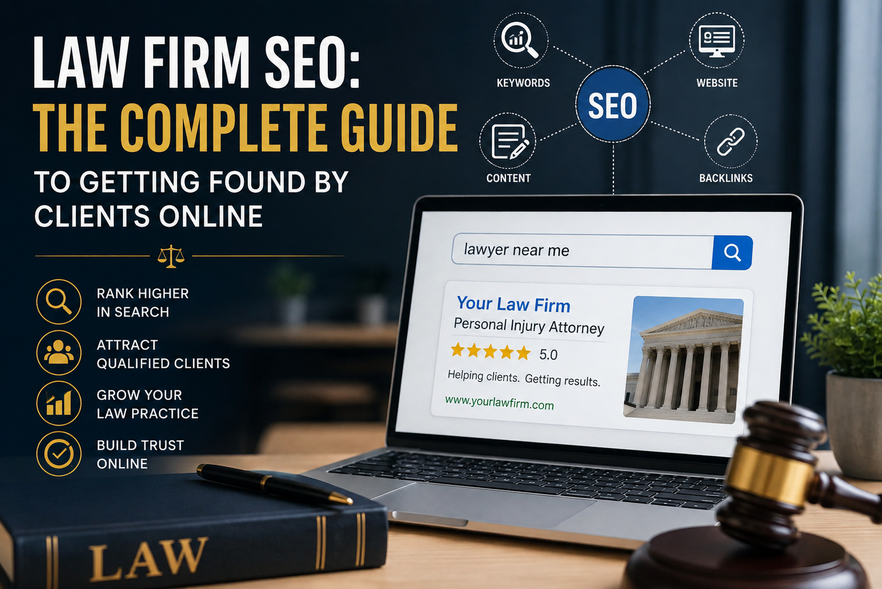
If someone needs a lawyer today, the first thing they do isn’t open the phone book or ask around at church. They open Google. A 2025 consumer study by iLawyerMarketing found that 86.7% of consumers said they would use Google when researching a lawyer for an important legal issue, making it by far the most-used online source in the study. ChatGPT was gaining ground, with 28.1% saying they would use it, but 94% of those ChatGPT users also said they would use Google. If your firm isn’t showing up when potential clients search for legal help, you’re not just missing a click. You’re potentially missing the opportunity to be considered at the exact moment someone is researching which attorney to hire.
That’s the whole reason law firm SEO matters. This guide covers what SEO actually means in a legal context, why it’s worth the investment, whether it really works for law firms, and how long you should expect it to take before you see results.
What Does SEO Mean in Law?
SEO stands for search engine optimisation. In a legal context, it means the work a firm does to its website and online presence so it ranks higher in the free, unpaid results on Google and other search engines, as opposed to paid ads that stop working the second you stop paying for them.
When a law firm’s website is properly optimised, it shows up higher on the results page when someone searches for terms connected to that firm’s practice areas and location, things like “family lawyer in Manchester” or “personal injury solicitor near me.” The higher you rank, the more of that search traffic ends up on your site instead of a competitor’s.
The Core Building Blocks of Law Firm SEO
The core building block of law firm SEO is:
On-page and on-site SEO
On-page SEO is the work you do to individual pages on your website: title tags, headings, meta descriptions, the actual written content, and image alt text, all tailored to a specific practice area. On-site SEO refers to the same idea applied across the whole website rather than a single page. Together, they help search engines understand exactly what each page is about and who it’s relevant to, which is the foundation everything else builds on.
Local SEO services
For the vast majority of law firms, local search is where the real business comes from. Nobody searches for “family lawyer” in isolation. They search for “family lawyer near me” or “family lawyer in [city].” Local SEO services typically cover:
- Optimising your website content around local keywords and locations you serve
- Setting up and maintaining your Google Business Profile
- Building a steady flow of genuine client reviews
- Keeping your firm’s name, address, and phone number consistent across every directory and listing site
Local SEO is important for law firms because it’s the layer that connects your online presence to real, nearby clients who are ready to act. A firm that ignores this piece is essentially invisible to anyone searching with a location in mind, which is most people.
Keyword research
Good SEO starts with knowing exactly what potential clients type into Google. Effective keyword research identifies the specific phrases people use when they’re looking for legal help, whether that’s broad terms like “divorce lawyer” or more specific, high-intent phrases like “no win no fee personal injury solicitor in Leeds.” Building your content around the right keywords ensures you’re attracting the people actually looking for what you do, rather than just chasing traffic for its own sake.
Content marketing
Once you know which keywords matter, you need somewhere to put them to work. That usually means blog posts, practice area pages, and guides that genuinely answer the questions your prospective clients are asking. Good legal content does two things at once: it targets the right search terms, and it demonstrates the expertise that makes someone trust you enough to pick up the phone.
Technical SEO
Technical SEO covers how well your website actually functions from a search engine’s perspective. That includes site speed, mobile friendliness, a clean site structure, and making sure nothing is blocking search engines from crawling and indexing your pages properly. It’s not the most visible part of SEO, but a technically broken website can undo even the best content and keyword strategy.
Link building
Backlinks, meaning links from other websites pointing back to yours, are one of the strongest signals search engines use to judge how authoritative and trustworthy a website is. For law firms, that often means getting mentioned by local news outlets, legal directories, bar associations, or industry publications. It’s slow, relationship-driven work, which is exactly why so many firms outsource it rather than trying to build links themselves.
The Benefits of SEO Services for Law Firms
Beyond simply appearing in search results, a solid SEO programme brings a handful of concrete benefits to a firm.
More qualified enquiries. People searching for a specific type of lawyer in a specific location already know what they need. Ranking for those searches brings in visitors who are much further along in the decision to hire someone than a cold lead ever would be.
Lower cost per client over time. Paid search ads can work, but you pay for every single click, and that cost disappears the day your budget runs out. SEO takes longer to build, but the rankings you earn keep sending traffic to your site without an ongoing per-click cost.
Stronger credibility and trust. Ranking near the top of Google carries a certain amount of implied authority. Combine that with genuinely useful content and strong client reviews, and your firm starts to look like the obvious, trustworthy choice before a prospective client has even picked up the phone.
A better return on your marketing spend. Once a page is ranking well, it keeps generating enquiries month after month with comparatively little extra effort, which makes SEO one of the more efficient channels in a law firm’s marketing budget over the long run.
Does SEO Work for Law Firms?
Yes, and the data backs it up. Firms that invest in a proper SEO strategy consistently see more visibility, more website traffic, and more enquiries from people actively searching for legal help. It isn’t instant and it isn’t magic. It works because it puts your firm in front of people exactly when they’re looking, using content and site structure that both search engines and real visitors can actually understand.
The firms that struggle with SEO are usually the ones treating it as a one-off task rather than an ongoing part of their marketing. A website that was optimised once in 2022 and never touched again will slowly lose ground to competitors who keep publishing and refining their content. Done consistently, though, SEO is one of the most reliable ways for a law firm to bring in new business without relying entirely on referrals.
Why Law Firm SEO Matters?
Having a website in 2026 isn’t optional for a law firm, but a website that nobody finds doesn’t do much good either. SEO is what turns your website from a static online business card into an actual source of new client enquiries.
People can’t hire a lawyer they’ve never heard of. If your firm sits on page three of Google while a competitor sits at the top of page one, you’re losing clients you never even had the chance to compete for. Ranking well changes that. It puts your firm in front of people at the exact moment they’re looking for legal help, which is about as qualified as traffic gets.
SEO Services for Law Firms: Should You Hire Help?
SEO is learnable, but it’s also genuinely time-consuming and constantly changing as search engines update their algorithms. Most lawyers don’t have the spare hours to become SEO specialists on top of running a firm, which is why many turn to dedicated law firm seo services instead.
Hiring an expert typically gets you three things. First, their accumulated expertise, since a good agency has already spent years learning what works specifically for legal websites. Second, your own time back, since SEO is an ongoing job, not a one-time fix. Third, some protection against mistakes, since search engines can penalise sites that use outdated or manipulative tactics, and an experienced provider knows how to avoid that.
When you’re comparing seo services, look for firms with real legal industry experience and be wary of anyone who guarantees a specific ranking or who can’t clearly explain their process. No legitimate SEO provider controls Google’s algorithm, so guaranteed results are one of the clearest warning signs that something isn’t right.
How Long Does SEO Take for Law Firms?
This is the question almost every firm asks, and the honest answer is that it’s a long-term investment rather than a quick fix. Most firms start to see meaningful movement in rankings and traffic somewhere between three and six months in, with the strongest results usually building over a full year or more of consistent work.
The timeline depends on a few things: how competitive your practice area and location are, how strong your website’s technical foundation is to begin with, and how consistently you’re publishing content and earning backlinks. A firm in a smaller town competing for a niche practice area might see faster results than a personal injury firm trying to rank in a major city, where competition is fierce.
The tradeoff for that patience is durability. Unlike paid ads, which stop the moment you stop paying, the rankings and content you build through SEO tend to keep working for you well after the initial effort, which is exactly what makes it worth the wait.
Final Thoughts
Law firm SEO isn’t a single trick or a box to check off once. It’s the combination of a technically sound website, content built around what real clients are searching for, a strong local presence, and the ongoing authority that comes from genuine backlinks and reviews. So if you handle it in-house or bring in dedicated seo services, the goal stays the same: make sure that when someone in your area needs exactly the kind of help your firm provides, your website is the one they find first.