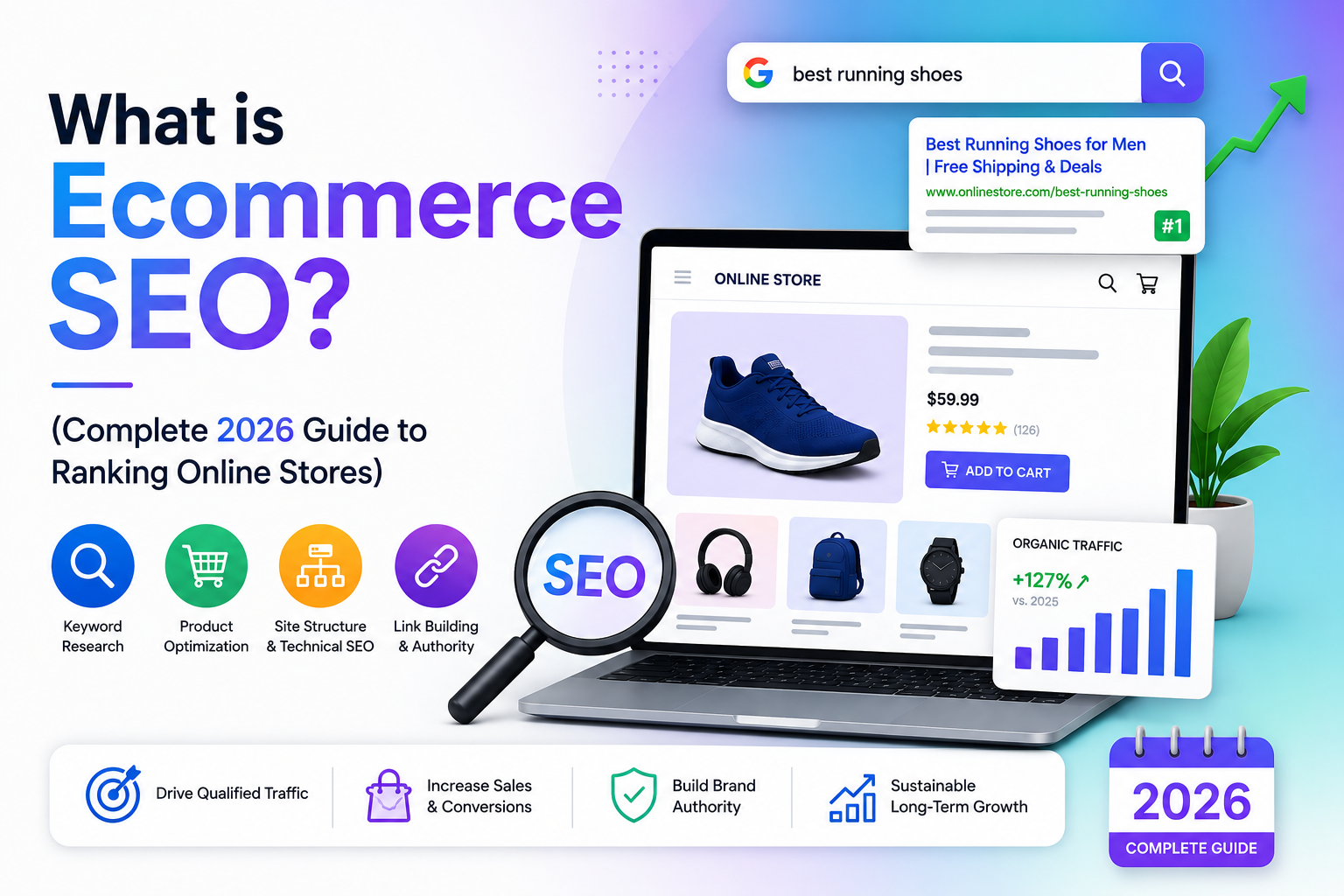
Ecommerce SEO (Search Engine Optimisation) is the process of optimising an online store to improve the visibility of product pages, category pages, and website content in search engines like Google. It works through keyword research, on-page optimisation, technical SEO, content marketing, internal linking, and backlink building to attract organic traffic and increase online sales. Unlike paid advertising, ecommerce SEO builds long-term visibility, improves brand authority, enhances user experience, and generates sustainable traffic without continuous ad spend.
A complete ecommerce SEO strategy includes optimising product and category pages, improving website speed and mobile responsiveness, targeting transactional and informational keywords, creating buying guides and blogs, and building authority through backlinks and structured data. Ecommerce SEO also supports AI-driven search systems, including Google AI Overviews and conversational search platforms, making online stores more discoverable across modern search experiences.
What Is Ecommerce Seo and How Does It Work?
Ecommerce SEO (Search Engine Optimisation) is the process of optimising an online store so that product pages, category pages, and blog content rank higher on search engines like Google. The goal is simple: attract free, organic traffic from people already searching for products you sell and convert them into paying customers.
It works by improving how search engines understand your store, products, and content. Google crawls your website, analyses your product structure, evaluates keywords, and compares your store with competitors. If your website is optimised properly, it appears higher in search results when users search for relevant products.
Unlike paid ads, ecommerce SEO builds long-term visibility. Once your pages rank, they can bring continuous traffic without paying for every click. That’s why ecommerce brands invest heavily in SEO instead of relying only on ads.
At its core, ecommerce SEO works through four major pillars: keyword targeting, on-page optimisation, technical SEO, and authority building.
What is an E-commerce SEO strategy?
It is a structured plan used to improve the visibility of an online store in search engines and increase product sales through organic traffic. A strong ecommerce SEO strategy focuses on understanding customer intent at every stage of the buying journey. This means targeting not only product keywords but also informational searches like comparisons, reviews, and buying guides.
A modern e-commerce SEO strategy includes:
- Keyword research based on product demand and search intent
- Optimised product and category pages
- Internal linking between related products
- Technical improvements like site speed and mobile optimisation
- Content marketing for blogs and buying guides
- Building authority through backlinks and mentions
In 2026, ecommerce SEO strategy is no longer just about ranking product pages. It also includes optimising for AI-driven search engines like ChatGPT and Google AI Overviews, where product recommendations are generated based on trust, reviews, and structured data.
Businesses that want scalable growth often combine strategy with SEO services to manage technical optimisation, content creation, and link building at scale.
What are the Key components of Ecommerce SEO?
Ecommerce SEO is made up of several important elements that work together to improve visibility and conversions.
Keyword research and search intent
Keyword research is the foundation of ecommerce SEO. It involves identifying what customers are searching for when they want to buy products.
There are three main types of keywords:
- Transactional keywords: “buy running shoes online”
- Informational keywords: “best running shoes for beginners”
- Navigational keywords: “Nike running shoes store”
A successful ecommerce store targets all three types to capture users at different stages of the buying journey.
On-page optimization for product pages
On-page SEO ensures that each product page is optimised for search engines and users.
This includes:
- Optimised product titles
- Clear meta descriptions
- Keyword-rich product descriptions
- High-quality images with alt text
- Structured headings and specifications
Well-optimised product pages help search engines understand exactly what you are selling.
Technical SEO for ecommerce websites
Technical SEO ensures that your online store is fast, mobile-friendly, and easy for search engines to crawl.
Key technical factors include:
- Website speed optimization
- Mobile responsiveness
- Clean URL structure
- Fixing crawl errors
- Proper indexing of category and product pages
Without strong technical SEO, even great content may not rank properly.
Content marketing for ecommerce growth
Content marketing plays a major role in ecommerce SEO. Blogs, guides, and FAQs help attract users who are still researching before buying.
For example:
- “Best laptops for students”
- “How to choose skincare products”
- “Top running shoes for marathon training”
This content builds trust and drives users toward product pages through internal linking.
Off-page SEO and backlinks
Backlinks from reputable websites increase your store’s authority. When other websites link to your store, Google sees it as a trusted source. This improves rankings for both product and category pages.
What is an Ecommerce SEO Checklist?
An e-commerce SEO checklist helps ensure your store is fully optimised for search engines and ready to compete.
Here is a practical checklist:
- Optimise product titles with keywords
- Write unique product descriptions (avoid duplicates)
- Add alt text to all product images
- Improve site speed and mobile performance
- Set up internal linking between related products
- Create SEO-friendly category pages
- Use structured data (schema markup)
- Fix broken links and crawl errors
- Optimise URLs (short and keyword-based)
- Add customer reviews for trust signals
This checklist ensures your store is not only visible but also competitive in search rankings.
What is an Ecommerce SEO Guide? (step-by-step overview)
An Ecommerce SEO guide typically follows a step-by-step process to build and optimise an online store.
Step 1: Start with keyword research based on products and customer intent.
Step 2: Optimise category pages for broad search terms.
Step 3: Optimise product pages with detailed descriptions and keywords.
Step 4: Improve technical SEO for speed and indexing.
Step 5: Build internal linking between related products and blogs.
Step 6: Publish supporting content like buying guides and comparisons.
Step 7: Build backlinks to increase authority.
Step 8: Monitor performance and improve based on analytics.
This process ensures long-term organic growth instead of short-term traffic spikes.
What are the Benefits of E-Commerce Seo?
E-commerce SEO offers long-term, sustainable growth for online stores by helping products appear in front of users who are already searching with buying intent. Unlike paid ads that stop when the budget ends, SEO continues to generate traffic and sales over time, making it one of the most cost-effective marketing channels for e-commerce businesses.
One of the biggest benefits is consistent organic traffic. When product pages and category pages rank on Google, they can bring daily visitors without ongoing ad spend. This creates a stable foundation for revenue growth, especially for stores with limited marketing budgets.
Another major benefit is higher trust and credibility. Users naturally trust organic search results more than advertisements. When your store appears on the first page of Google, it signals authority and reliability, which increases the chances of conversions.
E-commerce SEO also improves user experience and website structure. Optimising site speed, navigation, internal linking, and mobile responsiveness not only helps rankings but also makes shopping easier for customers, leading to higher conversion rates.
In addition, SEO helps businesses target customers at every stage of the buying journey, from awareness to purchase. This includes informational searches like “best running shoes” as well as transactional searches like “buy Nike Air Max online.”
Finally, SEO provides long-term ROI. Once pages are optimised and ranking, they continue to perform without ongoing ad costs, making it one of the highest-return digital strategies in the e-commerce space.
What are the Challenges of E-Commerce Seo?
While e-commerce SEO is powerful, it also comes with several challenges that make it more complex than standard website SEO.
One major challenge is high competition. Most e-commerce industries are extremely saturated, meaning you are competing with large brands, marketplaces like Amazon, and established online stores that already have strong authority and backlinks.
Another challenge is the large website size and complexity. E-commerce websites often contain hundreds or thousands of product pages. Managing SEO for such a large structure requires strong technical systems, proper internal linking, and continuous optimisation.
Duplicate content issues are also very common in e-commerce SEO. Many stores use manufacturer descriptions or similar product variations, which can lead to duplicate content problems that affect rankings.
Technical SEO challenges are another major factor. Issues like slow page speed, poor mobile optimisation, crawl errors, and improper indexing can prevent search engines from properly understanding and ranking product pages.
Additionally, keyword targeting can be difficult because users search in many different ways. A single product may have multiple search intents, and missing even a few variations can result in lost traffic.
Finally, e-commerce SEO requires constant updates and maintenance. Product availability changes, seasonal trends shift, and algorithms evolve, meaning SEO is not a one-time task but an ongoing process.
How to Implement Effective SEO Strategies for E-commerce?
Implementing effective SEO strategies for eCommerce requires a structured approach that combines technical optimisation, content strategy, and authority building.
The first step is keyword research and mapping. You need to identify what customers are searching for and map those keywords to the right pages. Product pages should target transactional keywords, while category pages should target broader search terms.
Next is on-page optimisation. This includes optimising product titles, descriptions, images, URLs, and meta tags. Each product page should be unique, descriptive, and optimised for both users and search engines.
A strong focus should also be placed on technical SEO improvements. This includes improving website speed, ensuring mobile responsiveness, fixing crawl errors, and creating a clean site structure that search engines can easily navigate.
Internal linking is another critical step. You should connect related products, categories, and blog content to help distribute authority and improve user navigation. For example, a blog about “best running shoes” should link to relevant product pages.
Content marketing is also essential. Creating blogs, buying guides, and comparison articles helps attract users who are still in the research phase. This content can then guide users toward product pages through internal links.
Another important strategy is building authority through backlinks. When other websites mention or link to your store, it increases trust and improves rankings in competitive niches.
Finally, continuous optimisation is key. Monitor performance, update product pages, improve underperforming content, and adapt to algorithm changes regularly.
By combining all these elements, e-commerce businesses can build a strong SEO system that drives consistent traffic, improves visibility, and increases sales over time.
What are the famous Ecommerce SEO Services Agencies?
Many businesses choose professional help instead of doing SEO themselves. This is where e-commerce SEO agency services come in.
An ecommerce SEO agency typically handles:
- Full store optimization
- Keyword research and content planning
- Technical SEO fixes
- Link building campaigns
- Conversion optimization
For example, agencies like Ecommerce SEO Coalition Technologies are known for providing structured ecommerce optimisation strategies that focus on scaling online stores through organic search growth.
If you don’t have in-house expertise, investing in ecommerce SEO services can significantly improve rankings and revenue.
Some businesses also look for specialised WooCommerceSEO services, especially if they are running WordPress-based stores. These services focus on optimising WooCommerce product pages, plugins, and site performance for better visibility.
Why is Ecommerce SEO Important?
Ecommerce SEO is crucial because it creates long-term, sustainable traffic. Unlike paid ads, which stop when the budget ends, SEO continues to bring customers over time.
It also builds trust. Customers are more likely to buy from stores that appear organically in search results rather than paid ads. Additionally, SEO helps improve user experience through better site structure, faster loading speeds, and clear product navigation.
Conclusion
Ecommerce SEO is not just about ranking products on Google, as it is about building a complete system that attracts, educates, and converts customers. In 2026, successful online stores are not just advertising; they are being discovered. And ecommerce SEO is what makes that discovery possible.
FAQs
1. What is ecommerce SEO in simple words?
Ecommerce SEO is the process of optimising an online store, so products appear in Google search results and attract free organic traffic.
2. What is ecommerce SEO strategy?
It is a structured plan that includes keyword research, product optimisation, technical SEO, content marketing, and backlinks to increase store visibility and sales.
3. Do I need ecommerce SEO services for my store?
Yes, if you want long-term organic growth without relying only on paid ads, ecommerce SEO services help improve rankings and conversions.
4. What is included in ecommerce SEO packages?
Ecommerce SEO packages usually include keyword research, on-page optimisation, technical SEO, content creation, and link building, depending on the plan.